
About Us
By the end of today, an estimated 130 people will have died by suicide in the United States.1 This startling fact highlights our nation’s growing mental health epidemic where:
When we formed TARA Mind in 2022, we did so with the belief that our nation’s outdated mental health system – plagued by issues surrounding accessibility, cost, care quality and treatment efficacy – needed a new approach to address this gargantuan and escalating problem. And so, with a clear mission to tackle health equity barriers that have traditionally prevented individuals struggling with mental health from getting effective care, we set out to build a company that enables access to affordable ketamine-assisted therapy (KAT).
We are a Public Benefit Corporation whose purpose, by definition and mission, extends beyond profit. TARA Mind was established to have an enduring positive impact on society and the large number of people who are struggling with their mental health. Our approach is rooted in a commitment to safety, science and sound clinical practice. To meet our ambitious mandate, we are building a values-based system that aligns the interests of multiple stakeholders: Providers, Individuals and Employers.
Providers
Higher
Reimbursements
Community
Learning
Operational
Efficiencies
Clients
Educational
Resources on KAT
Trusted
Recommendations
Affordable Quality Care
Employers
Fewer Disability Claims
& Reduced Medical
Costs for Employers
Higher Productivity
via Reduced Absenteeism
Lower Turnover,
Higher Retention
For an overwhelming number of Americans grappling with mental health conditions, the future feels bleak:
The TARA Mind Provider Network
To expand access for individuals in need, we are building a network of vetted and highly qualified providers that includes physicians and specially-trained therapists.
There is a supply-and-demand imbalance between practitioners willing and able to provide quality care and individuals in need of effective mental health support. This is a serious problem where:
The TARA Mind Platform
Our Protocol
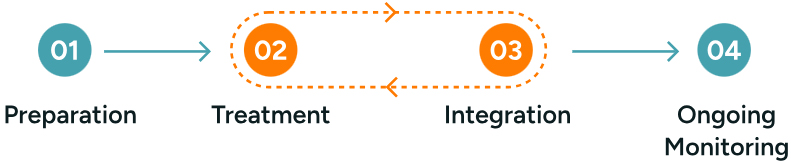
We have codified The TARA Mind Way™, a proprietary set of standards established in partnership with clinicians to guarantee the availability of wraparound services for their clients and drive treatment efficacy. This clinician-guided process is known as PTIM™ and ensures that individuals who receive treatment through the TARA Mind Provider Network are afforded care that incorporates the hallmarks of effective and comprehensive treatment: Preparation, Treatment, Integration and Monitoring.
The TARA Mind Commitment
At TARA Mind, we are committed to giving individuals the resources and access they need to take control of their mental health; supplying providers with the tools they need to drive optimal outcomes and to get paid for doing so; and presenting employers with a solution for the mental health benefits their employees are so urgently seeking.
The TARA Mind Value Proposition
Footnotes
1American Foundation for Suicide Prevention (n.d.) Suicide Stats.
2Anxiety & Depression Association of America (n.d.).
3Howes, O., Thase, M., Pillinger, T. (2021, July 13). Treatment Resistance in Psychiatry: State of the art and new directions. Molecular Psychiatry.
4SAMHSA (2022 December). Key Substance Use and Mental Health Indicators in the United States: Results from the 2021 National Survey on Drug Use and Health. P.1. Dept. of Health and Human Services.
5SAMHSA (2020 September). Key Substance Use and Mental Health Indicators in the United States: Results from the 2019 National Survey on Drug Use and Health. P.3. Dept. of Health and Human Services.
6Cohen Veterans Network (2018 October 10). America’s Mental Health 2018.
7Mental Health America (2023). The State of Mental Health in America.
8NAMI (2017 November). The Doctor is Out: Continuing Disparities in Access to Mental and Physical Health. P. 5. National Alliance on Mental Illness.
9Meadows Mental Health Policy Institute (2021 March). Measurement-Based Care in the Treatment of Mental Health and Substance Use Disorders. P. 3.
10Fortney, J., et al. (2015). Fixing Behavioral Health Care in America. P. 4. The Kennedy Forum.
11Fortney, J., et al. (nd). Fixing Mental Health Care in America. P. 1. The Kennedy Forum.